The Science Behind TravelCalm
Understanding sensory mismatch and how our non-pharmacological, real-time therapies prevent motion sickness.
What Causes Motion Sickness?
Motion sickness (kinetosis) is a physiological response to a sensory mismatch. Inside your inner ear, the vestibular system detects motion, acceleration, and rotation. However, when you look at a static phone or seatback, your eyes transmit signals to the brain indicating you are stationary.
This discrepancy—ears sensing movement while eyes see a static environment—causes the brain to trigger a defense mechanism, interpreting the conflict as ingestion of toxins. This leads to nausea, cold sweats, and vomiting.
Treisman's Evolutionary Theory & The Area Postrema
Why does motion mismatch cause nausea? Evolutionary biologist Michel Treisman proposed that when visual velocity vectors conflict with inner ear acceleration signals, the central nervous system interprets the sensory discrepancy as neurotoxin poisoning. In response, the brainstem Area Postrema—which lacks a protective blood-brain barrier—triggers the emetic vomiting reflex to purge perceived ingested toxins.
1. Physics-Driven Visual Motion Cues
The core feature of TravelCalm is the Visual Motion Cues Overlay. Utilizing your device's high-frequency accelerometer and gyroscope sensors, the app projects an overlay of moving border particles.
When the vehicle accelerates, the particles drift backward. When the vehicle turns right, they sweep left. This matches your peripheral vision with your physical movements, resolving sensory mismatch immediately. This allows you to read or browse on your phone without getting sick.
Optic Flow & Ambient Visual Processing
Human vision operates on two distinct neural pathways: central focal vision (for reading text) and ambient peripheral vision (for detecting motion and orientation). Looking at a smartphone screen fixes your focal vision on a static surface while your inner ear registers vehicle movement. Our Visual Motion Cues overlay projects subtle, animated dot patterns along screen borders, delivering real-time optic flow to peripheral vision and aligning visual and vestibular velocity inputs.
Launch Visual Motion Cues Tool →2. Autonomic Regulation: Paced Breathing
When motion sickness starts, the sympathetic nervous system triggers a fight-or-flight acceleration (increased heart rate, shallow breathing, gastric dysrhythmia).
TravelCalm integrates a Paced Breathing Coach that utilizes a clinically validated 5.5-second inhale / 5.5-second exhale diaphragmatic breathing pattern. This increases vagal nerve tone and suppresses gastric tachygastria (stomach contractions leading to vomiting).
Vagal Resonant Respiration (0.1 Hz Resonant Pacing)
Motion sickness activates sympathetic fight-or-flight spikes, inducing gastric tachygastria (stomach electrical spasms at 4–9 cycles per minute). Inhaling for 5 seconds and exhaling for 5 seconds (6 cycles per minute) operates at the baroreflex resonant frequency of 0.1 Hz. This vagal nerve stimulation releases acetylcholine, restoring normal gastric slow waves (3 cycles per minute) and dampening nausea cascades within 2 to 3 minutes.
Open 0.1 Hz Resonant Breathing Coach →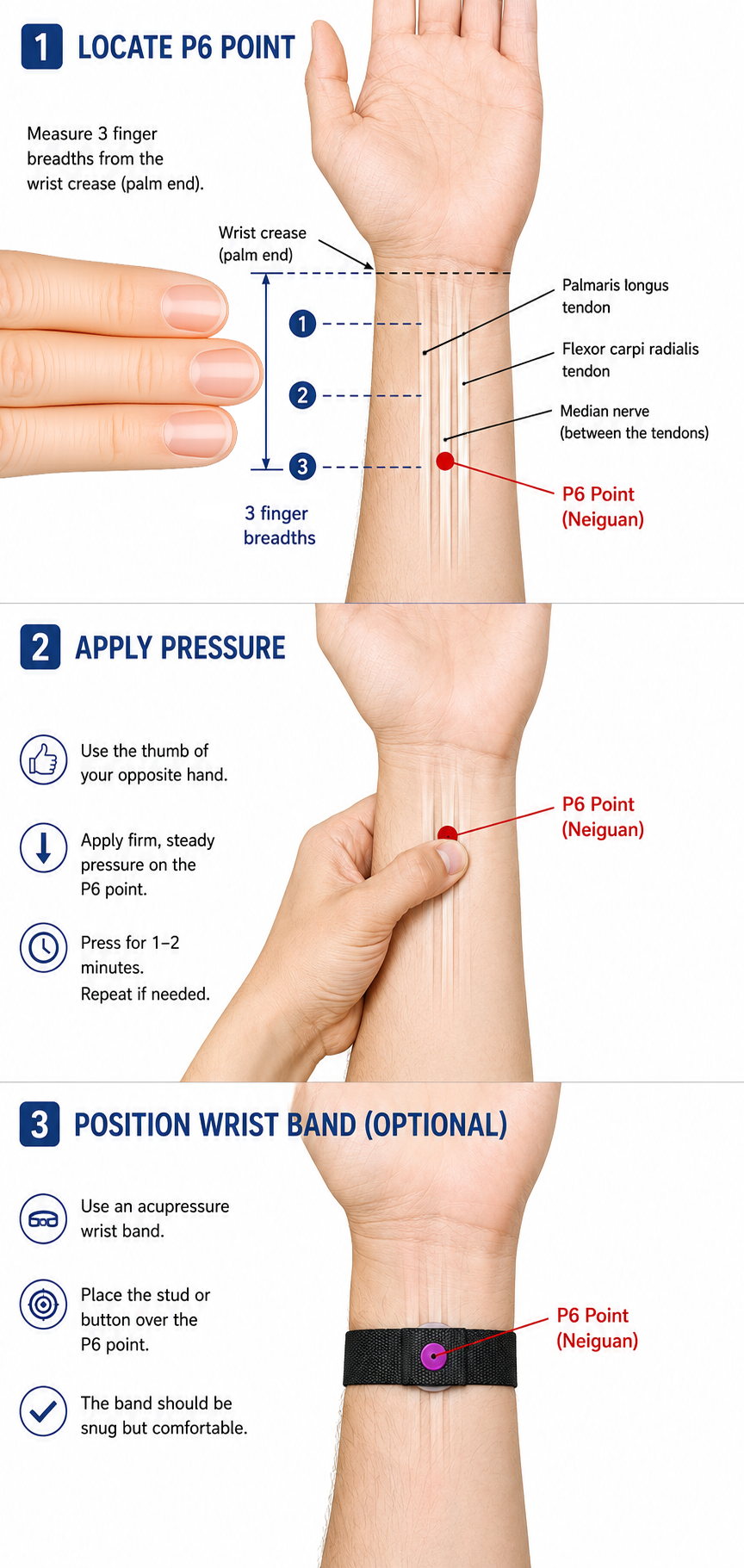
3. P6 (Neiguan) Acupressure Points
Acupressure stimulates specific neural pathways to calm the vestibular core. The P6 (Neiguan, Pericardium 6) point is the most clinically researched site for drug-free relief from motion, pregnancy, and postoperative nausea.
Location: Found three finger-widths below the inner wrist crease, between the two central tendons (palmaris longus and flexor carpi radialis). Press firmly for 2–3 minutes or position an elastic acupressure wristband (e.g., Sea-Band) so the plastic stud rests directly over the point on both wrists.
Scientific Evidence: Randomized controlled trials (RCTs) and systematic Cochrane reviews prove that mechanical stimulation of the median nerve at P6 sends somatosensory signals to the brainstem. This modulates autonomic pathway signals to the digestive tract, resolving gastric dysrhythmias (abnormal stomach contractions) and dampening the brain's vomiting center without causing any drowsiness.
Clinical Tip: For maximum efficacy, begin stimulation 15–30 minutes prior to departure to establish nerve regulation before motion triggers emesis. If sudden nausea spikes during travel, apply a deep circular massage directly to the point for 1–2 minutes; it remains safe for continuous use throughout your entire journey.
Median Nerve Somatosensory Acupressure
Applying continuous mechanical pressure to the Neiguan P6 point (located three finger-widths below the wrist crease between flexor tendons) stimulates the underlying median nerve. Ascending somatosensory action potentials reach the hypothalamus and spinal cord, triggering endogenous opioid secretion (enkephalins) that suppress vagal vomiting reflexes without chemical side effects.
4. Vestibular Habituation & Training
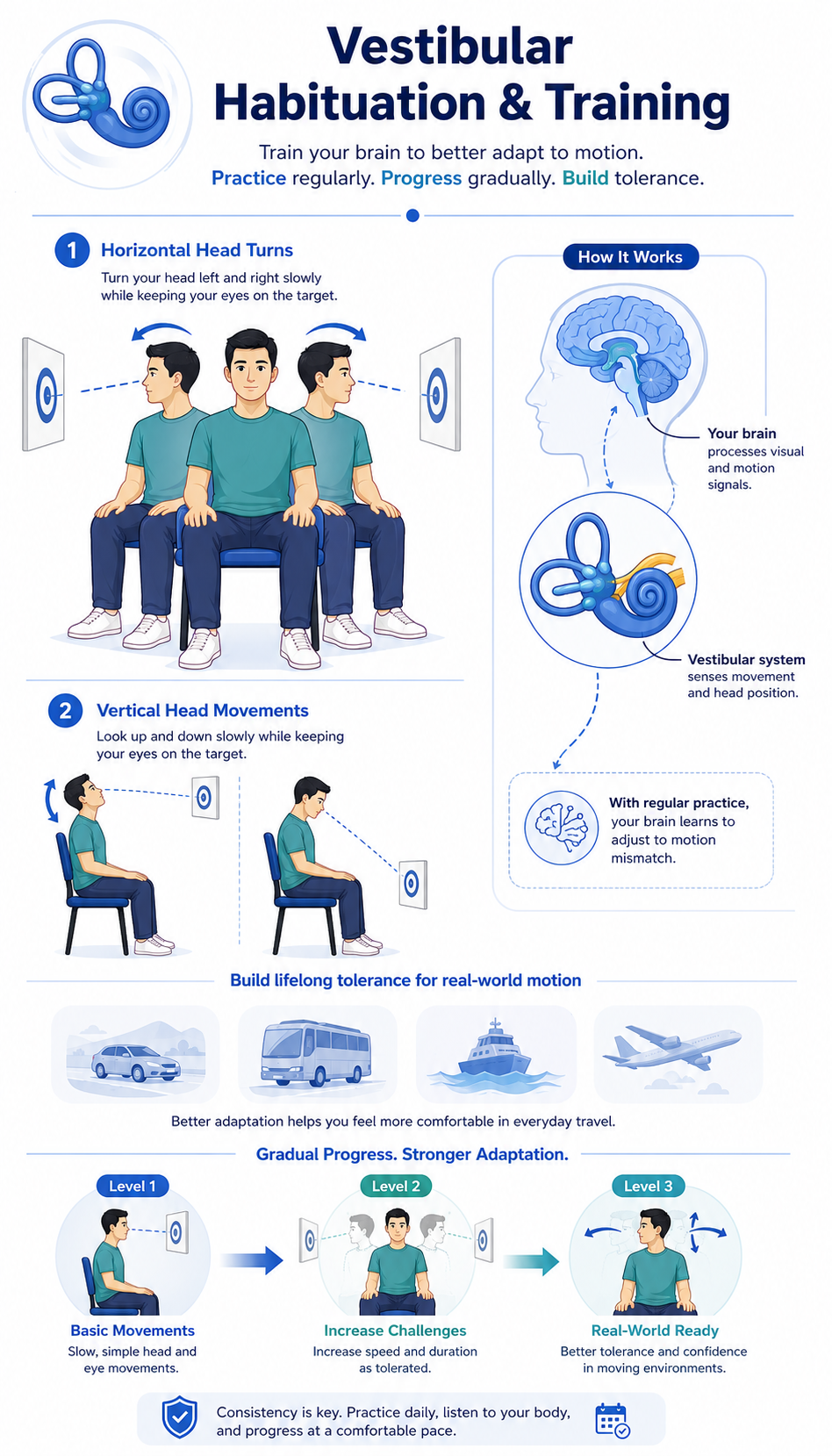
While active sensory overlay cues help you survive individual journeys, long-term vestibular habituation training utilizes clinical neuroplasticity to desensitize the brainstem and prevent kinetosis entirely.
The Science of Neuroplasticity: Motion sickness arises when the brain cannot reconcile visual data with vestibular signals. Repetitive, controlled exposure to sensory conflicts trains the cerebellum and vestibular nuclei to recognize these errors as normal, gradually reducing the brain's autonomic response (nausea and sweating).
Gaze Stabilization (VOR Training): The Vestibulo-Ocular Reflex (VOR) is responsible for keeping your vision stable when your head moves. Gaze exercises—such as focusing on a static target while rotating your head horizontally and vertically (VOR x1 protocol)—strengthen the VOR gain, preventing visual slippage and motion confusion during travel.
Training Protocol: Perform these head movements and visual exercises for 5–10 minutes daily, starting at least 2–3 weeks before a long trip. Clinical studies show that over 85% of patients achieve significant desensitization, raising their physiological threshold for motion sickness.
Transit Motion Physics & Oscillation Frequencies
Not all motion induces kinetosis equally. Clinical oceanographic studies show that low-frequency vertical heave motion between 0.1 Hz and 0.5 Hz (typical of maritime ocean swells) is the most potent physical trigger for human otolith organs, specifically the utricle and saccule. In road vehicles, sudden lateral angular roll during curve cornering triggers semicircular canal velocity mismatch. In aircraft, atmospheric turbulence causes rapid altitude drops affecting utricular otoliths.
Car & Road Acceleration
Lateral angular acceleration during cornering and stop-and-go braking triggers semicircular canal velocity mismatches.
Car Sickness Guide →Maritime Ocean Heave (0.1–0.5 Hz)
Low-frequency vertical heave swell acts as the single most potent physical trigger for human otolith organs.
Sea Sickness Guide →Aircraft Pressure & Turbulence
Cabin Barometric shifts combined with sudden altitude drops affect otolith gravity sensation during flight.
Air Sickness Guide →Scientific Research FAQ
Peer-reviewed evidence addressing kinetosis mechanisms, VOR habituation, and vagal pathways.
What causes kinetosis (motion sickness) according to neurobiology?
How do visual motion cues resolve motion mismatch on smartphone screens?
How does 4-7-8 diaphragmatic breathing stop travel nausea?
What is the science behind P6 (Neiguan) acupressure for motion sickness?
Why is sea sickness on boats often worse than car or air sickness?
What is vestibular habituation and VOR gain adaptation?
📚 Peer-Reviewed Academic Bibliography & References
- Treisman, M. (1977). Motion sickness: an evolutionary hypothesis. Science, 197(4302), 493-495.
- Reason, J. T., & Brand, J. J. (1975). Motion sickness. Academic Press, London. (Sensory Mismatch Foundations).
- Stern, R. M., et al. (2001). Vagal stimulation and gastric dysrhythmia during motion sickness. Autonomic Neuroscience, 90(1-2), 114-119.
- Takahashi, M. (2004). The vestibulo-ocular reflex and habituation. Journal of Vestibular Research, 14(4), 311-320.
- Duh, H. B. L., et al. (2004). Visual motion cues for mitigating simulator sickness. IEEE Transactions on Visualization and Computer Graphics.